Sunday, July 20, 2008

British PM demands end to Israel settlements

British PM demands end to Israel settlements

Story Highlights
NEW: Brown: "Settlement expansion has made peace harder to achieve"
Was Brown's first trip to Israel and Palestinian territories as Britain's leader
Brown spoke at news conference with Palestinian President Mahmoud Abbas
He arrived in Israel after visiting Iraq where he met with PM Nouri al-Maliki


BETHLEHEM (AP) -- British Prime Minister Gordon Brown demanded Sunday that Israel cease settlement construction and promised more money to jump-start the battered Palestinian economy.

In his first trip to Israel and the Palestinian territories as Britain's leader, Brown repeatedly stressed that economics are key to Mideast peace and said Israel should ease travel restrictions in the West Bank that have hindered commerce.

But his strongest comments were reserved for the settlements: "I think the whole European Union is very clear on this matter: We want to see a freeze on settlements.

"Settlement expansion has made peace harder to achieve. It erodes trust; it heightens Palestinian suffering; it makes the compromises Israel needs to make for peace more difficult," Brown said at a news conference with Palestinian President Mahmoud Abbas in the West Bank town of Bethlehem.

Abbas went further in his criticism of Israel's construction in disputed east Jerusalem and the adjacent West Bank, telling Brown that Israel lacks commitment to the "principles and spirit" of Mideast peace efforts. He singled out stepped-up construction of homes for Jews in areas of Jerusalem the Palestinians claim for their capital.

At a joint appearance after meeting Brown later in Jerusalem, Israeli Prime Minister Ehud Olmert acknowledged that Israel disagrees with the Palestinians and Britain over the issue of settlements but added, "I am absolutely convinced, Mr. Prime Minister, that this should not stand in the way of an agreement between us and the Palestinians."

Olmert repeated his contention that agreement is "closer than ever" and said he hoped for an accord by the end of the year.

Israel and the Palestinians resumed peace talks late last year at a U.S.-backed conference in Annapolis, Maryland. Both sides had originally aspired to reach a final peace deal by the end of the year but have backed away from that goal somewhat because of arguments over settlements and whether the Palestinians are capable of enforcing security in areas they control.

Under the first phase of the internationally backed "road map" peace plan, which forms the basis of the negotiations, Israel was to freeze all settlement construction and the Palestinians were to crack down on militant groups.

The international community is trying to bolster Abbas' moderate government, and Brown said Britain would donate $60 million on top of $500 million the British government has pledged to the Palestinians over the next three years.

He spoke of the need to create jobs by building industrial parks, promoting small businesses and putting up desperately needed housing. He announced plans to host an international investment conference for the Palestinians in the fall and promised to help the Palestinians train their security forces.

Peace efforts are also complicated by the fact that the Gaza Strip is ruled by militants from Hamas. Ismail Haniyeh, who heads the Hamas government in Gaza, said Sunday that Brown should visit Gaza to see the "humanitarian crisis" caused by Israel's blockade of the territory, "unfortunately with the participation of several countries, including European countries and the British themselves."

Israel imposed a partial blockade on Gaza in response to rocket fire from the territory on southern Israel. A cease-fire currently in effect has decreased the rocket fire and has led Israel to increase the trickle of goods entering Gaza.

Brown's two-day visit to the region has been overshadowed by a claim from a Shiite militia holding five British hostages in Iraq that one of the captives killed himself.

The British leader arrived in the region after visiting Iraq, where he met with Prime Minister Nouri al-Maliki and discussed the plight of the British hostages kidnapped by a Shiite group a year ago. Shortly after his departure, he called the report that one of the men had committed suicide "a very distressing development" and demanded that the Shiite militia "immediately and unconditionally" release the Britons.

The British government has yet to authenticate the group's claim.

Copyright 2008 The Associated Press. All rights reserved.


Find this article at: http://www.cnn.com/2008/WORLD/europe/07/20/brown.israel.ap/index.html?eref=rss_latest

Pictures from a friend

The birth of a ladybug/ladybird

From my friend Angie in UK


I know some of you enjoy my weird and wonderful photos, so I thought I would share a rather unique experience I recently had. Hands up who has seen the life cycle of a ladybird? Anyone seen one being born? Well here's a little nature lesson for you then First of all, this is how the poor lovely ladybird begins its life. Yes this ugly little critter is in the early stages of becoming what we all know and love


Oh but it gets worse! You see the shell has to harden up next, and they they have to do these rather unflattering yoga poses!


But then comes the big moment, when its time to break loose and get some sun and spots, and here it is happening ...


But then the poor little chap gets a real complex when he sees himself for the first time and realises he got his colours all wrong


Oh well, better luck next time! LOL!
********************************************

Saturday, July 19, 2008

A Muslim woman too orthodox for France

A Muslim woman too orthodox for France
By Katrin Bennhold
Friday, July 18, 2008

LA VERRIÈRE, France: When Faiza Silmi applied for French citizenship she was worried that her fluent French was not quite perfect enough or that her Moroccan upbringing would pose a problem.

"I would never have imagined that they would turn me down because of what I choose to wear," Silmi said, her hazel eyes looking out of the narrow slit in her niqab, an Islamic facial veil that is among three flowing layers of turquoise, blue and black that cover her body from head to toe.

But last month, France's highest administrative court upheld a decision to deny Silmi, 32, citizenship on the ground that her "radical" practice of Islam was incompatible with French values like equality of the sexes.

It was the first time that a French court had judged somebody's capacity to be assimilated into France based on private religious practice, taking laïcité - the country's strict concept of secularism - from the public sphere into the home.

The case has sharpened the focus on the delicate balance between the tradition of Republican secularism and the freedom of religion guaranteed under the French Constitution - and how that balance might be shifting. It comes four years after a law banning religious garb in public schools was reinforced. And it comes only weeks after a court in Lille annulled a marriage on request of a Muslim husband whose wife had lied about being a virgin. (The government subsequently demanded a review of the court decision.)

So far, citizenship has only been denied on religious grounds in France when applicants were believed to be close to fundamentalist groups.

The ruling has received almost unequivocal support across the political spectrum, including among many Muslims. Fadela Amara, the French minister for urban affairs, called Silmi's niqab "a prison" and a "straitjacket."

"It is not a religious insignia but the insignia of a totalitarian political project that promotes inequality between the sexes and is totally lacking in democracy," said Amara, herself a practicing Muslim of Algerian descent.

François Hollande, the leader of the opposition Socialist Party, called the ruling "a good application of the law," while Jacques Myard, the conservative lawmaker elected in the constituency where Silmi lives, demanded that face-covering veils be outlawed.

In an interview, Silmi told of her shock and embarrassment when she found herself unexpectedly in the public eye. Since July 12, when Le Monde first reported the court decision, her story has been endlessly dissected on newspaper front pages and in late-night television talk shows.

"They say I am under my husband's command and that I am a recluse," Silmi said during an hourlong conversation in her apartment in La Verrière, a small town 30 minutes southwest of Paris. At home, when there are no men present, she lifts her facial veil and exposes a smiling, heart-shaped face.

"They say I wear the niqab because my husband told me so," she said. "I want to tell them: It is my choice. I take care of my children and I leave the house when I please. I have my own car. I do the shopping on my own. Yes, I am a practicing Muslim, I am orthodox. But is that not my right?"

Silmi declined to have her photograph taken, saying that both she and her husband were uncomfortable with the idea.

Silmi married Karim, a French national of Moroccan descent, eight years ago and moved to France with him. Their four children, three boys and a girl, aged from 2 to 7, were all born in France. In 2004, Silmi applied for French citizenship, "because I wanted to have the same nationality as my husband and my children." But her request was denied a year later because of "insufficient assimilation" into France.

She appealed, invoking the right to religious freedom. But late last month the Council of State, the judicial institution with final say on disputes between individuals and the public administration, upheld the ruling.

"She has adopted a radical practice of her religion, incompatible with essential values of the French community, particularly the principle of equality of the sexes," said the ruling.

Emmanuelle Prada-Bordenave, the government commissioner who reported to the Council of State, said Simli's interviews with social services revealed that "she lives in total submission to her male relatives. She seems to find this normal and the idea of challenging it has never crossed her mind."

But everything is not as Western cliché might have it in the Silmi household. As she recounts her story, it is her husband who serves a steaming pot of mint tea and chocolate cookies. Silmi herself collected this interviewer from the rail station in her car. She does not wear her facial veil while driving and says that she also lifts it when she picks up her children at the local public school.

"What hurts me most is that people who don't know me judge me like this," she said. Journalists got many facts wrong, she said, starting with the number of her children and ending with the assertion that she refused to take off her veil when she was interviewed for her citizenship. "It is simply not true," she said.

M'hammed Henniche of the Union of Muslim Associations in the Seine-Saint-Denis district north of Paris, fears that the ruling may open the door to what he considers ever more arbitrary interpretations of what constitutes "radical" Islam.

"What is it going to be tomorrow? The annual pilgrimage to Mecca? The daily prayer?" said Henniche. "This sets a dangerous precedent. Religion, so far as it is personal, should be kept out of these decisions."

In one sign of the nature of some of the criteria used to evaluate Silmi's fitness to become French, the government commissioner approvingly noted in her report that she was treated by a male gynecologist during her pregnancies.

The Silmis say they live by a literalist interpretation of the Koran. They do not like the term Salafism, although they say literally it means following the way of the prophet Muhammad and his companions.

"But today 'Salafist' has come to mean political Islam; people who don't like the government and who approve of violence call themselves Salafists. We have nothing to do with them," said Karim Silm, a soft-spoken man with a visible prayer mark on his forehead and a religious beard.

His wife explains that in 2000 she decided to wear the niqab, a dress code typically found on the Arabian Peninsula, because in her eyes her traditional Moroccan attire - a flowing djelaba with head scarf - was not modest enough. "I don't like to draw men's looks," she said. "I want to belong to my husband and my husband only."

She has given herself until September to decide whether to challenge the ruling.

France is home to nearly five million Muslims, roughly half of whom are French citizens. Criteria for granting French citizenship include "assimilation," which normally focuses on how well the candidate speaks French.

Lately, though, President, Nicolas Sarkozy has stressed the importance of "integration" into French life. Part of his tougher immigration policy is a new law to make foreigners who want to join their families take an exam on French values as well as French language before leaving their countries.

Karim, a former bus driver who says he is finding it hard to get work because of his beard, dreams of moving his family to Morocco or Saudi Arabia. "We don't feel welcome here," he said. "I am French but I can't really say that I am proud of it right now."

Copyright © 2008 The International Herald Tribune www.iht.com

'It's gonna be a bloodbath,' fallen soldier told father

updated 9:30 p.m. EDT, Fri July 18, 2008


'It's gonna be a bloodbath,' fallen soldier told father


Cpl. Gunnar Zwilling had a bad feeling about


his final mission in Afghanistan, said his father, Kurt.


First Lt. Jonathan P. Brostrom surprised his mother,

Mary Jo, on Mother's Day at his parents' Hawaii home.


Cpl. Matthew B. Phillips had a smile on his face in
every photo from Afghanistan, said his father, Michael.


'It's gonna be a bloodbath,' fallen soldier told father


Story Highlights
U.S. soldiers who died in Afghanistan were a few days from completing deployment
Some wanted money for school; others wanted to start a career in military
Relatives seek to reconcile their grief with their anger toward the military


By Emanuella Grinberg, CNN


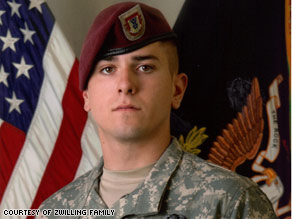
(CNN) -- Cpl. Gunnar Zwilling suspected that his days were numbered last week, while he and his band of brothers in the 173rd Airborne Brigade Combat Team prepared for a mission near Wanat, Afghanistan.

"It's gonna be a bloodbath," he told his father, Kurt Zwilling, on the phone in what would be their last conversation.

Kurt Zwilling braced himself for the worst but held out hope that his son would make it home.
"They were in the most dangerous place on Earth. They were in mortal danger, and there was nothing they could do about it," he said. "But they were soldiers, so they had to do their job."

With just a few days left in their 15-month tour, Gunnar Zwilling and eight of his comrades were killed July 13 in a clash with as many as 200 Taliban militants during a mission to set up an outpost near Wanat. It was the deadliest attack on U.S. troops in Afghanistan in three years.
In the wake of their deaths, the paratroopers have become symbols of what many say is a forgotten war, prompting the U.S. military to draw up plans for putting more troops and resources into the war in Afghanistan.

But before they were national heroes, the young soldiers were beloved sons, brothers, fathers and husbands who were drawn to the Army for different reasons.

Cpl. Jason D. Hovater, 24, of Clinton, Tennessee, joined the Army against his family's wishes with the intention of jump-starting his college education.

Before joining the service in 2006, Hovater was a "man of God" who divided his time between his father-in-law's landscaping company and playing songs of worship with his family.

"Everything that God deposited in that boy came out when he played the piano," said his mother, Kathy Hovater, who home-schooled her son and his three siblings.

Shortly after Hovater joined his combat team in Italy, his sister said, he called home and said he had made a mistake but was committed to following through with his service.

"He was a dedicated soldier. He did what he was supposed to do because he said if he weren't over there, all that horror and torment that was going on in the war, it would be over here," said his sister, Jessica Davis.

Cpl. Pruitt A. Rainey, 22, of Haw River, North Carolina, also joined the Army as a means to pay for his college education so he could become a teacher, according to Jeff Terrell, the leader of the youth group at the Glen Hope Baptist Church.

"He wasn't going to be a career military guy, but he believed in what he was doing," said Terrell, who knew Rainey since his teen years. "He felt like this would help him. He enjoyed it, but he had other plans.

"He really wanted to teach. He had a good way with kids. Kids flocked to him."

Before joining the Army, Rainey spent his time doing martial arts, a pastime that came naturally to the high school wrestling star, and volunteering for his church's youth ministry.

"The kids loved to jump on him like he was a big bear," Terrell said. "He was a big kid, but he was gentle."

Cpl. Jonathan R. Ayers, 24, of Snellville, Georgia, seemed destined for military service since childhood.

"Jon was just very military since he was 3 years old. He looked at your shoes, and if they weren't perfect, they were no good," said his father, Bill Ayers. "He loved the regiment of the military; he loved order and schedule."

Despite his fastidious tendencies, Ayers' father remembers him as a "cutup" who never failed to amuse with his Jeff Foxworthy impersonation.

"He loved to see people smile and laugh," Ayers said. "He was not a prankster, but he loved to tell jokes."

For the free-spirited Cpl. Matthew B. Phillips, 27, of Jasper, Georgia, the armed forces satisfied a need for adventure while providing a service to his country.

"Matt had a very individualistic personality. He loved living life," said his father, Michael Phillips. "Even though he was afraid at times, in every photo from Afghanistan, he had a big smile on his face."

Phillips, who left a wife behind, died on the same day his sister gave birth to her first son, whom she named after him.

Like other grieving relatives, Phillips' father is attempting to reconcile his emotions with concerns over how the military handled the situation.

"We're torn between incredible pride and anger. We're having a difficult time reconciling that after 14 months, someone who served his country well and paid his dues, why would he be placed in such a perilous situation?" Phillips said.

"There have to be some answers for the family."

Dean Bogar, the grandfather of Cpl. Jason M. Bogar, 25, of Seattle, Washington, said he was troubled by the fact that his grandson was fighting in a Taliban stronghold with little reinforcements.

"That's a big question mark," he said.

Even so, he said, he is proud of his grandson for bringing "valor" to the Bogar name.

"He was a nifty boy. He had a great sense of humor and was outgoing and very bright and upfront with everything," he said. "Kind of clever little imp."

In the beginning, Kurt Zwilling said, his son enjoyed the camaraderie, discipline and excitement that Army life offered.

"Everything he did, he did with a passion," Kurt Zwilling said of his son, who graduated from high school in Florissant, Missouri. "That's why he wanted to join the paratroopers: He wanted to go into the toughest thing and be with the best."

Even as the deteriorating situation in Afghanistan became apparent, Zwilling said, his son applied the same determination to his service that had carried him through high school theater, sports and music.

"He walked into the valley of death and didn't flinch. He knew what was going to happen, and he went anyway. That's bravery," he said.

For the parents of 1st Lt. Jonathan P. Brostrom, 24, of Aiea, Hawaii, knowing that their son died doing what he felt was right brings some sense of closure.

"He was very happy doing what he was doing, and he wouldn't have had it any other way," said his mother, Mary Jo Brostrom. "That was what he wanted to do, defend our freedom and serve with his brothers."

Brostrom's parents said they are grateful they had the chance to spend time with their son in May, when he showed up unexpectedly at their door on Mother's Day with a bouquet of flowers.
He spent the next few weeks surfing, fishing and spending every waking moment with his parents and his 6-year-old son, Jase.

"When he came home, he would wrestle around and try and make us laugh," Mary Jo Brostrom said. "He had a beautiful smile and a beautiful heart, and that's what we'll miss."


Find this article at:
http://www.cnn.com/2008/US/07/17/airborne.soldiers.family/index.html?iref=mpstoryview

A few "let's piss off Michelle" stories

Vatican 'regrets' female bishops decision
updated 9:03 a.m. EDT, Tue July 8, 2008


Story Highlights
NEW: Move a rift to apostolic tradition of ordaining only men as bishops, says Vatican
Church of England's General Synod passed resolution allowing female bishops
Some traditionalists threaten to leave Anglican Church for Roman Catholic Church
First consecration of a female bishop could happen in 2015


(CNN) -- The Vatican said Tuesday it regrets the decision by the Church of England's governing body to allow the ordination of women as bishops.

The move by the Anglican Church's General Synod "is a rift to the apostolic tradition" of ordaining only men as bishops, the Vatican said in a statement, and is another obstacle to reconciliation between Anglicans and Roman Catholics.

"This decision will have consequences on the dialogue which had brought good fruits," the Vatican statement said.

The General Synod passed a resolution Monday night that allows women to become bishops, acting over the objections of traditionalists who argued that Jesus only wanted men in leadership positions.

Some traditionalists have threatened to abandon the Anglican Church for the Roman Catholic Church if women become bishops. Several hundred Anglican priests made that move when women were first ordained 16 years ago.

The synod narrowly rejected a proposal for "super bishops," which would have allowed parishes opposed to female bishops to opt out. Opponents argued the plan would be insulting to female bishops.

The Church of England has about 114 bishops. They supervise parishes in Britain.

The final hurdle for the consecration of female bishops is expected in February with a vote on a "code of practice" intended to protect people who as "a matter of theological conviction will not be able to receive the ministry of women as bishops or priests."

The first consecration of a female bishop could happen in 2015.

The theological debate over female bishops has centered on the question "What would Jesus do?"

The traditionalists argued that bishops must be men, as were Jesus and his apostles.

Retired Canon Alan Duke, a longtime supporter of women in church leadership posts, said those arguments "simply do not stack up."

Duke said that while Jesus named no female disciples, he used and valued woman in radical and different ways for his time.

"He was hardly going to choose women and send them into a situation where they might have been in grave risk," Duke said.

Christina Rees, with the pro-women lobby Women and the Church, described what was at stake as "an acceptance by the Church of England of women on equal terms as men in the ordained ministries."

David Holding, a traditionalist church member, said he does not object to female bishops, but "there must be a proper provision made for those who can't go along with it."

The lack of a provision to allow traditionalists to choose to be under a "super bishop" instead of a woman raises concern that a schism could develop in the Church of England.

Duke described "an awful lot of bluster" but doubted there "will be a mass exodus."


Find this article at: http://www.cnn.com/2008/WORLD/europe/07/08/women.bishops/index.html


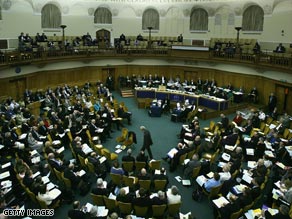
Anglicans seek to prevent church split


The Archbishop of Canterbury Rowan Williams (centre)

stands with bishops at the 10 yearly Lambeth Conference.


Story Highlights
Lambeth Conference, held every decade, brings together Anglican church leaders
Some bishops have boycotted event over gay clergy and female bishops
Conservative Anglican bishops decided last month to form their own movement
Anglican Communion is 3rd biggest church in the world, has 80M members


CANTERBURY, England (AP) -- The world's Anglican bishops turned Saturday to the enormous task at the heart of their once-a-decade summit: trying to keep the Anglican family from breaking apart over the Bible and homosexuality.


With its private prayer phase over, the Lambeth Conference gets down to business but is hobbled by a boycott: about one-quarter of the invited bishops -- mostly theological conservatives from Africa -- are not attending.


The 650 bishops who are here include a mix of traditionalists, moderates and liberals, all with divergent ideas about what Anglicans should believe and how their fellowship should operate.


The conference's opening public worship is set for Sunday in Canterbury Cathedral. The Archbishop of Canterbury Rowan Williams, the Anglican spiritual leader, has led a three-day closed-door session this week focused on the role of the bishops as seen through the Gospel.
Williams designed the entire gathering without any votes or resolutions. Instead, starting Monday, the bishops will hold daily Bible study and small group discussions. They plan to release their collective "reflections" on the meeting when it ends Aug. 3.


Some critics have said the program is an attempt to avoid decisive action. The 77 million-member Anglican Communion has been splintering since 2003, when the Episcopal Church, the U.S. Anglican body, consecrated the first openly gay bishop, V. Gene Robinson of New Hampshire.


Last month, Anglican conservatives -- frustrated that Williams hasn't done more to keep the U.S. church and other liberal Anglicans in line with traditional Bible teaching -- formed a new global church network that circumvents Williams' authority but stops short of schism.


A few leaders of that movement are attending Lambeth, but most have stayed away. They released a statement ahead of the Sunday service condemning "false teaching which justifies sin in the name of Christianity."


"These are not merely matters of different perspectives and emphases," they wrote. "They have led to unbiblical practice in faith and morals, resulting in impaired and broken communion. We long for all orthodox Anglicans to join in resisting this development."


Archbishop Phillip Aspinall, head of the Anglican Church of Australia, defended the conference design Saturday as "not backing away from the hard realities we have to face, but nurturing the right spirit" to confront them.


Williams has told bishops they must "call everyone together" instead of aligning with one group or another. He also said bishops must not only listen to the people they lead, but also consider what God wants of them, according to bishops who discussed details of the private talks.


In one session, Williams asked the bishops, seated in the nave of the historic cathedral, to go pray with another bishop who they feel nervous about meeting, according to U.S. Episcopal Bishop George Councell of New Jersey.


Several bishops said as they looked around the cathedral, they were struck by the tombstones of Anglican church leaders who had served hundreds of years ago. It was a good reminder not only of the history of the Anglican fellowship but also of its ability to survive turmoil.


"We've been at this a long time," Councell said.


The Anglican Communion is a global fellowship of churches that trace their roots to the missionary work of the Church of England. It is the third-largest group of churches in the world, behind Roman Catholics and Orthodox Christians.


The communion has long held together different views of ritual and Scripture. But it's biggest and fastest-growing churches are now in Africa and other developing regions where strict interpretation of the Bible is the norm.


The wealthy but much smaller liberal-leaning churches in the U.S., Canada and Western Europe have seen dramatic drops in membership.


Williams barred Robinson and a few other problematic bishops from the Lambeth Conference to ensure broader participation. But he invited U.S. leaders who consecrated Robinson and bishops from other Anglican provinces that accept gay relationships.


Robinson has traveled to Canterbury anyway, hoping to meet with as many overseas Anglican bishops as possible. Advocates for gay and lesbian Anglicans have also set up in Canterbury, planning an opening service of their own in another church on Sunday.


Copyright 2008 The Associated Press. All rights reserved.This material may not be published, broadcast, rewritten, or redistributed.


Find this article at: http://www.cnn.com/2008/WORLD/europe/07/19/church.anglican.ap/index.html?eref=rss_latest


____________________________________________________


Friday, July 18, 2008

Sniper targets teen asylum-seekers in Norway

Sniper targets teen asylum-seekers in Norway


  • Story Highlights
    Police say gunman fires at a Norwegian center for teenage asylum seekers
    Gunman used heavy caliber weapon and fired from long range, police say
    16-year-old Somali boy was seriously wounded
    Police helicopters and sniffer dogs searching for the shooter

ASKER, Norway (AP) -- Several shots were fired at a center for teenage asylum-seekers in Norway on Friday, and a 16-year-old Somali boy was seriously wounded, police said.

Police believe the shots were fired from long range, with a "heavy-caliber" weapon, police spokesman Einaar Aas said, without giving further details.

The boy was in his bed on the top floor of a two-story Hvalstad asylum center in Asker, outside Oslo, when a bullet pierced the wooden wall and hit him in the stomach, asylum center director Ahmed Bozgil told The Associated Press.

Aas said the boy was in critical condition at an Oslo hospital and would undergo surgery.

"It's to early to speculate about motives, but we are taking this very seriously," Aas said. Violence against refugees is rare in Norway, but an influx of immigrants recently has led to calls for tighter immigration controls.

It was unclear exactly how many rounds hit the building in the 8 a.m. (0600 GMT) shooting.
"It's the first time we have had any serious incidents like this here," Bozgil said. He said there were 121 youths from 13 countries at the center at the time of the shooting, but only the 16-year-old was hit.

Police helicopters and sniffer dogs searched the area for suspects, but no arrests had been made by Friday afternoon, the police spokesman said.

Last year about 6,000 asylum-seekers sought refuge in the Scandinavian country, and the number is expected to more than double this year.

The biggest numbers are coming from Iraq, Eritrea, Russia and Somalia.

Copyright 2008 The Associated Press. All rights reserved.This material may not be published, broadcast, rewritten, or redistributed.
All AboutNorway


Find this article at: http://www.cnn.com/2008/WORLD/europe/07/18/norway.shoot.ap/index.html?eref=rss_latest
Yusuf Islam wins damages for "veiled women" slur

Singer Yusuf Islam, formerly known as Cat Stevens, performs during the Live Earth concert at the soccer arena in Hamburg, northern Germany, July 7, 2007.REUTERS/Christian Charisius

Yusuf Islam wins damages for "veiled women" slur

1 hour, 35 minutes ago

British folk singer Yusuf Islam, formerly Cat Stevens, accepted libel damages and an apology on Friday from a news agency that reported he had refused to talk to women at an awards ceremony who were not wearing a veil.

The artist, who changed his name after becoming a Muslim in the late 1970s, will donate the "substantial" payout to Small Kindness, a U.N.-linked charity he chairs.

Adam Tudor, the singer's attorney, told London's High Court that the story behind the legal action was published by World Entertainment News Network and was used on Contactmusic.com, a website said to have 2.2 million page views a month.

The article appeared in March last year and suggested that the singer was "so sexist and bigoted that he refused at an awards ceremony to speak to or even acknowledge any women who were not wearing a veil," Tudor said.

"It went on to suggest that Mr. Islam's manager had stated 'Mr. Islam doesn't speak with women except his wife, least of all if they don't wear a headscarf. Things like that only happen via an intermediary."'

Tudor said the article had embarrassed the singer, creating a false impression of his attitude to women and also casting serious aspersions on his religious faith.

World Entertainment News Network issued an apology, saying:
"We now accept that these allegations ... are entirely without foundation, and that Mr. Islam has never had any difficulties working with women, whether for religious or for any other reason."

Islam, 59, is still best known for his hits as Cat Stevens, including "Wild World," "Morning Has Broken" and "Moonshadow."

He sold an estimated 60 million albums as Stevens, but retired from showbusiness in 1978 after converting to Islam. He released his first mainstream pop album since then in 2006.
Reuters/Nielsen

Copyright © 2008 Reuters Limited. All rights reserved.
This goes to show how so much misunderstanding and lack of knowledge of other peoples pervades even today's society! I remember that people wanted to destroy his albums a few decades ago when he converted and then again after 9/11. Idiots. If you ever listened to his music you'd know he never sang about anything but life and peace. And a lot of religious symbolism was already there. (I just found it strange going from Greek Orthodox to Islam, nothing wrong with that, but just struck me odd, at the time, welllll to be honest, still)